
FiiO JH13 Review – Fun & Fun & Fun
With the JH13, FiiO expands its Jade Audio line with a hybrid in-ear design built around a 1+2 driver architecture. A dynamic 10 mm unit ensures low-end authority, while the two BA drivers provide clarity and detail. Together with wooden faceplates and a lightweight housing, the JH13 targets mobile listeners seeking strong performance on a tight budget.
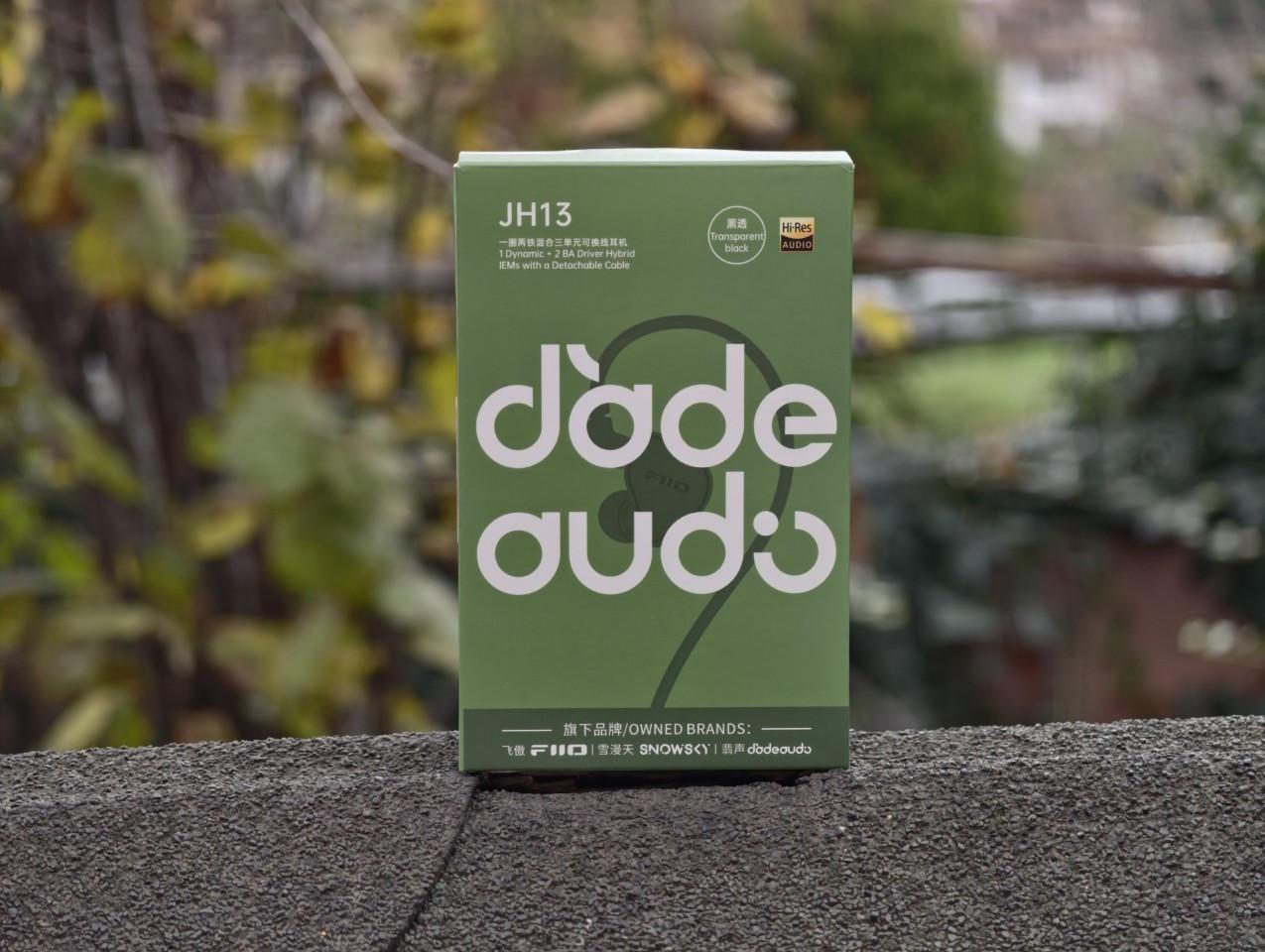
FiiO continues to broaden its Jade Audio portfolio with products that aim to balance affordability and acoustic ambition. Positioned squarely within the fast-growing hybrid IEM segment, the new FiiO JH13 brings together a 10 mm dynamic driver and two balanced armature units in a compact enclosure, enhanced by carefully selected materials such as real Zebrawood faceplates. This combination is designed to offer an accessible yet mature listening experience for mobile users who expect more than typical entry-level performance.
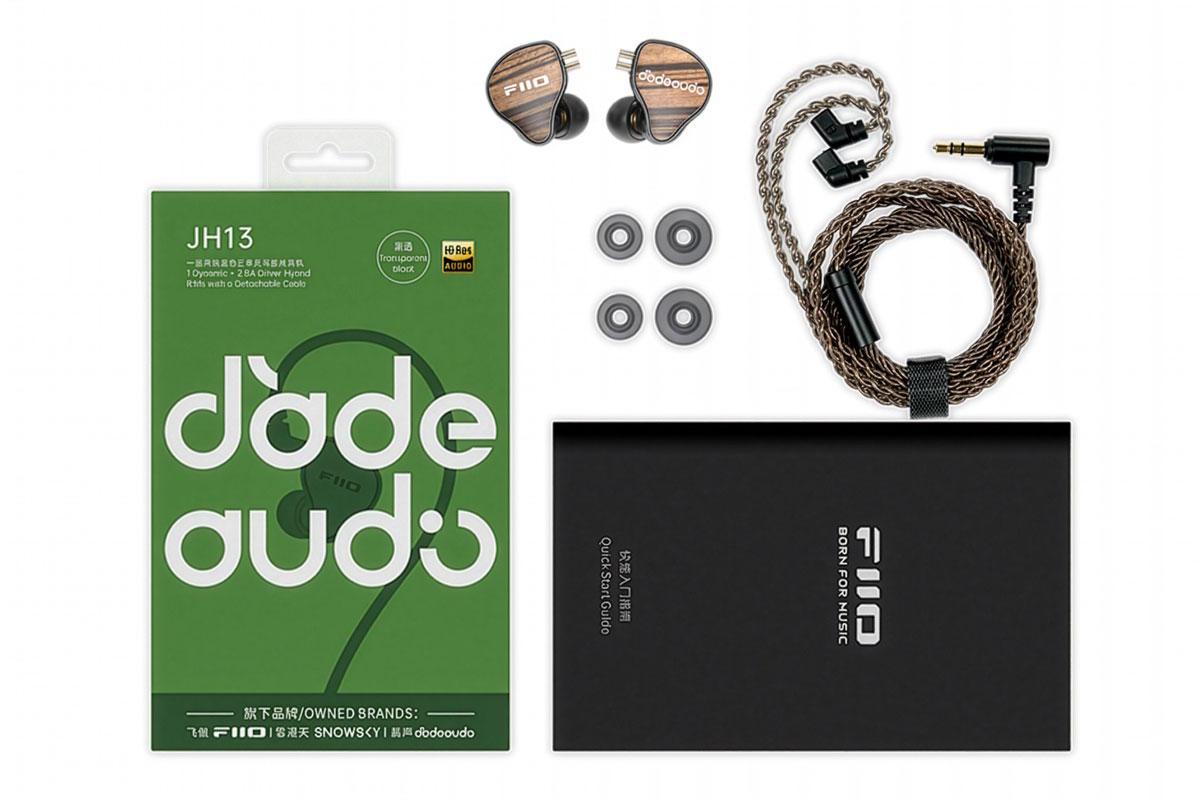
The FiiO JH13 employs a hybrid layout that leverages the advantages of multiple driver technologies within a compact shell. The 10 mm dynamic driver provides a firm, well-controlled low-frequency foundation, while the dual balanced armatures are tuned for clean treble reproduction with fine micro-detail. A coordinated crossover ensures smooth transitions between driver types, giving the JH13 a balanced and genre-friendly sound profile suitable for modern streaming libraries and offline content alike.
The hybrid concept is supported by an asymmetric internal and external magnet design. This approach increases flux density around the voice coil, allowing faster and more accurate movement of the diaphragm. In practice, this translates into improved transient response, enhanced transparency, and greater efficiency, making the JH13 easy to drive from smartphones, portable DACs, or compact audio players.
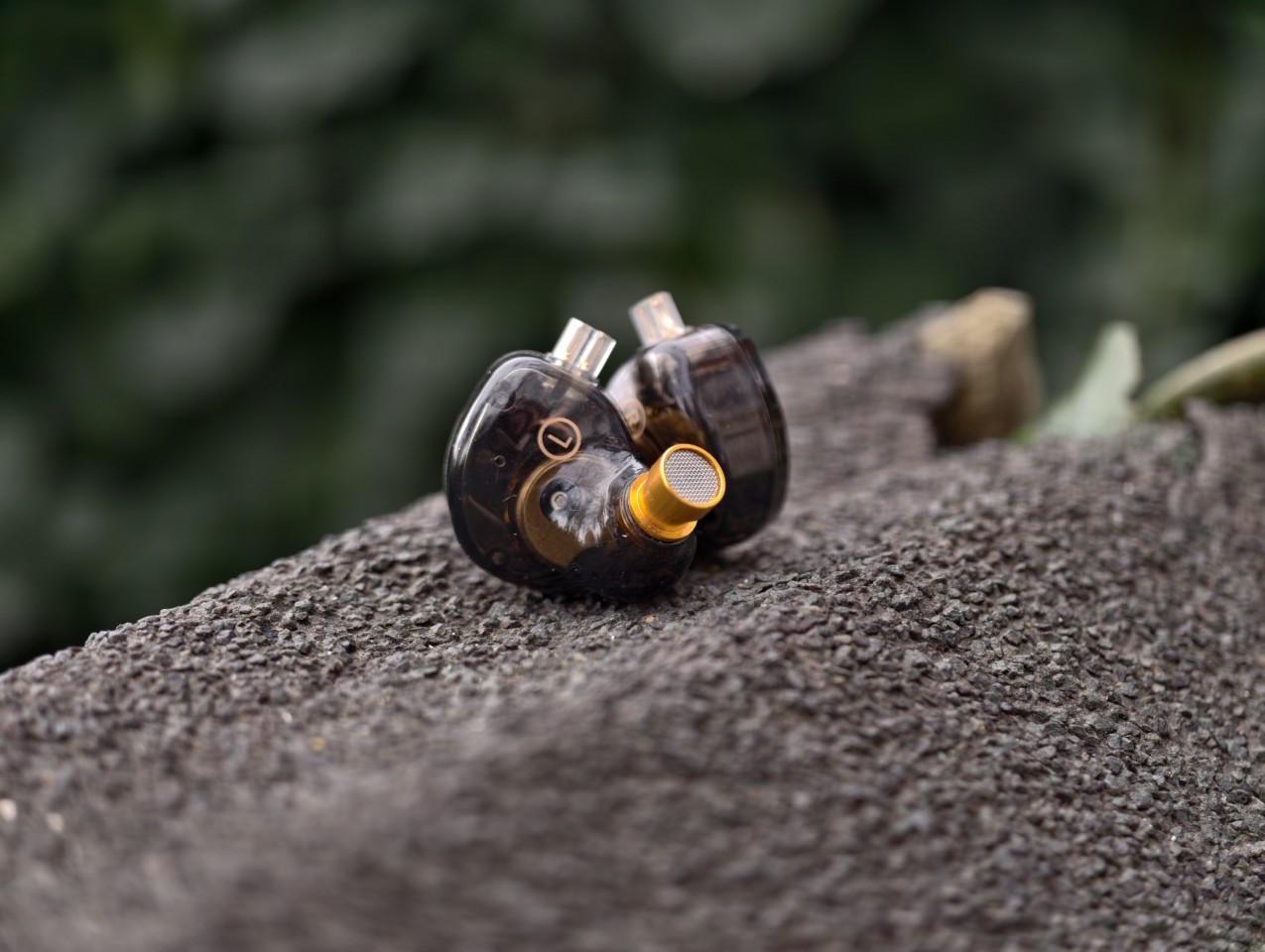
FiiO equips the dynamic driver with a lightweight CCAW voice coil, reducing moving mass and improving responsiveness. High-frequency content benefits from this design, especially instruments with fast transients such as percussion or string plucks. This technology, more commonly found in mid-range or premium models, contributes to the JH13’s refined upper-band performance.
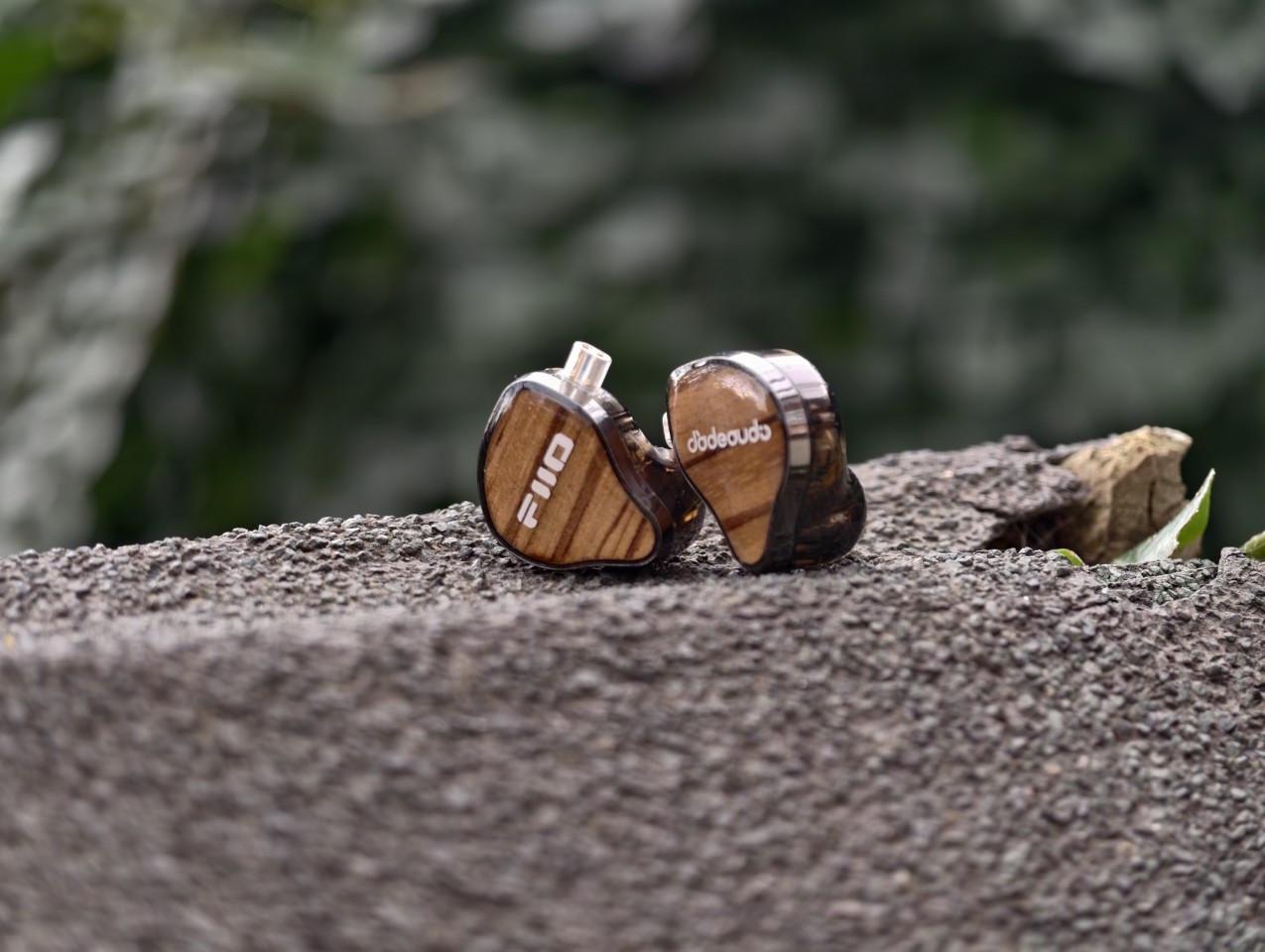
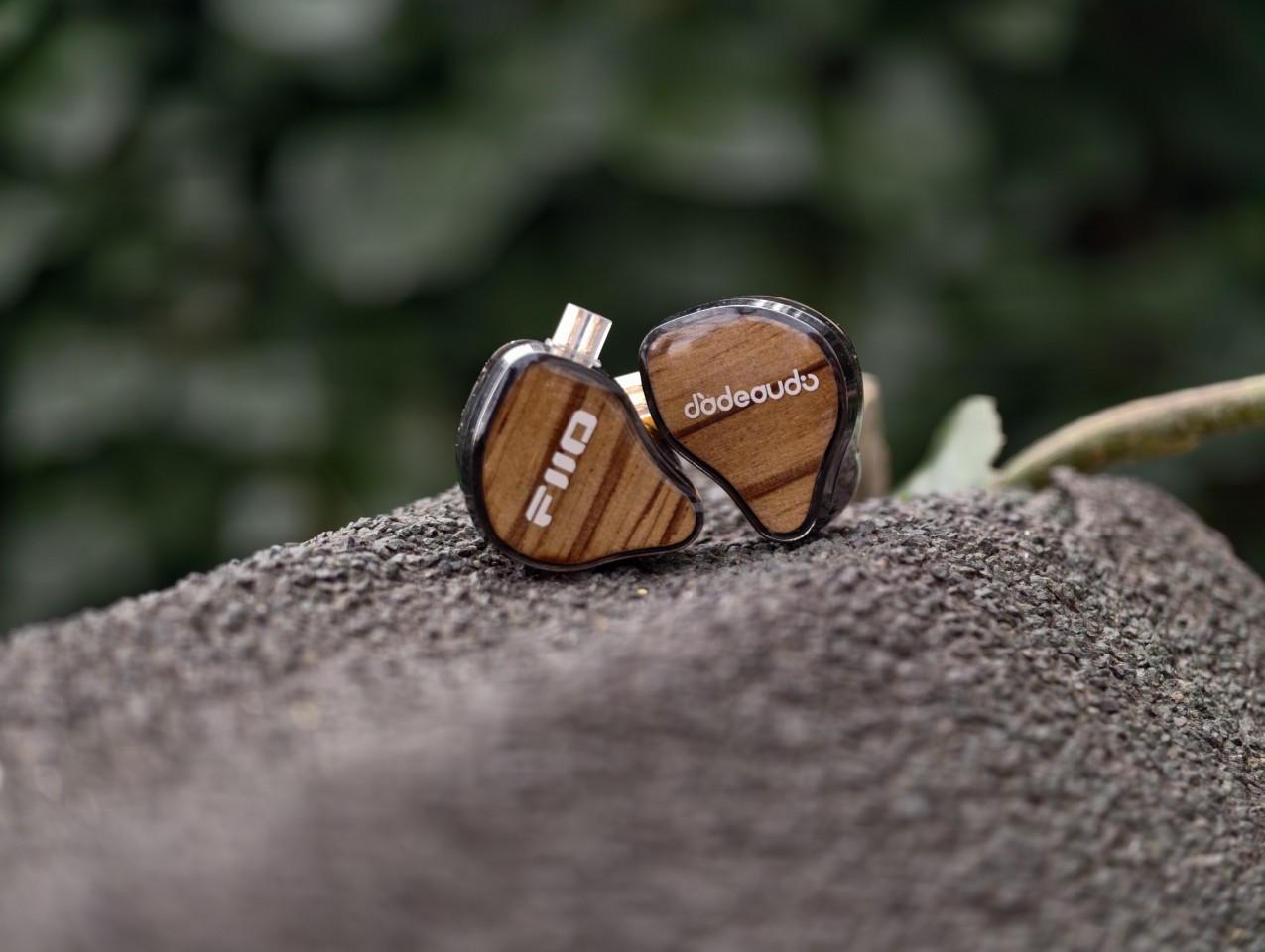
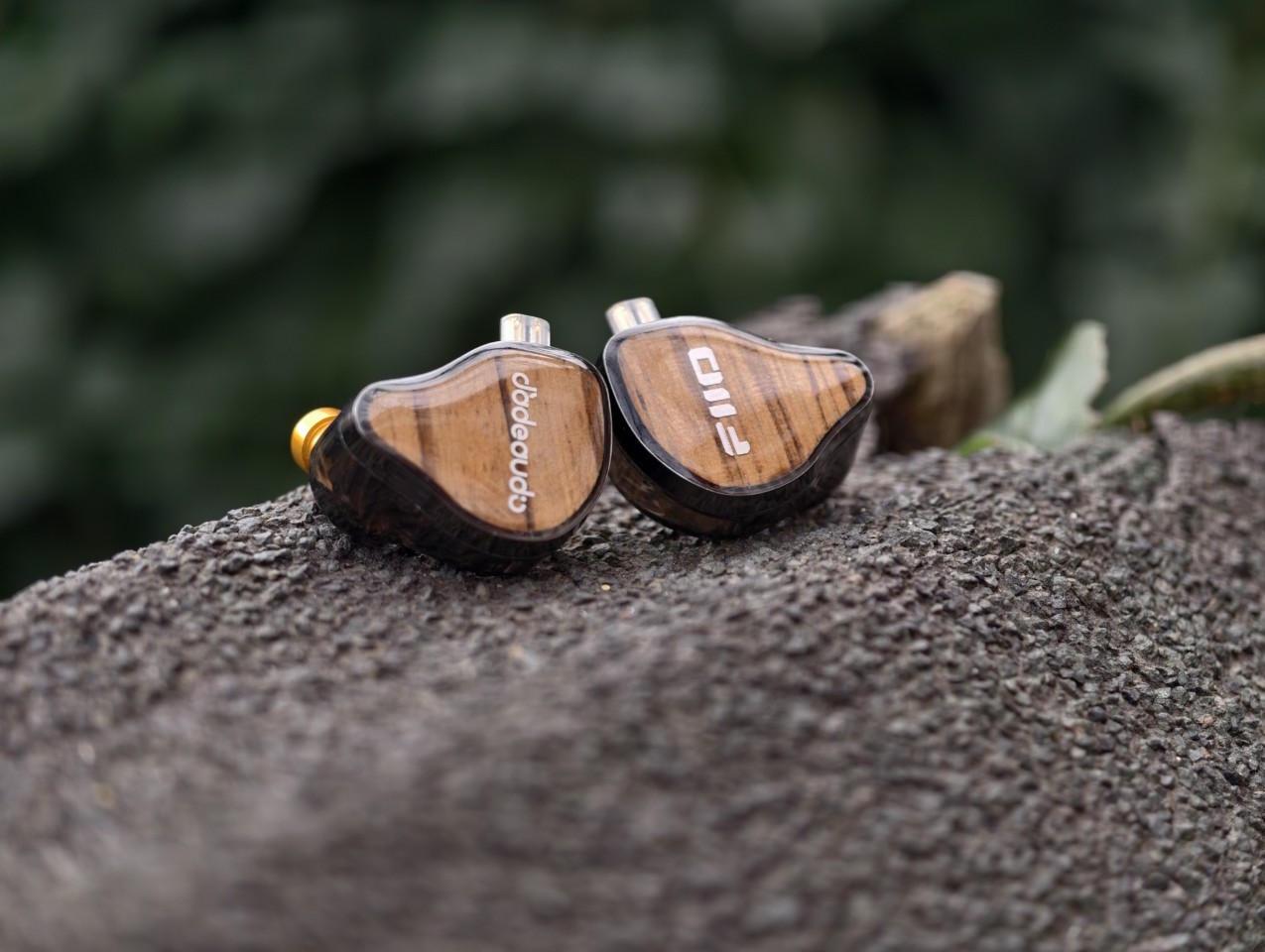
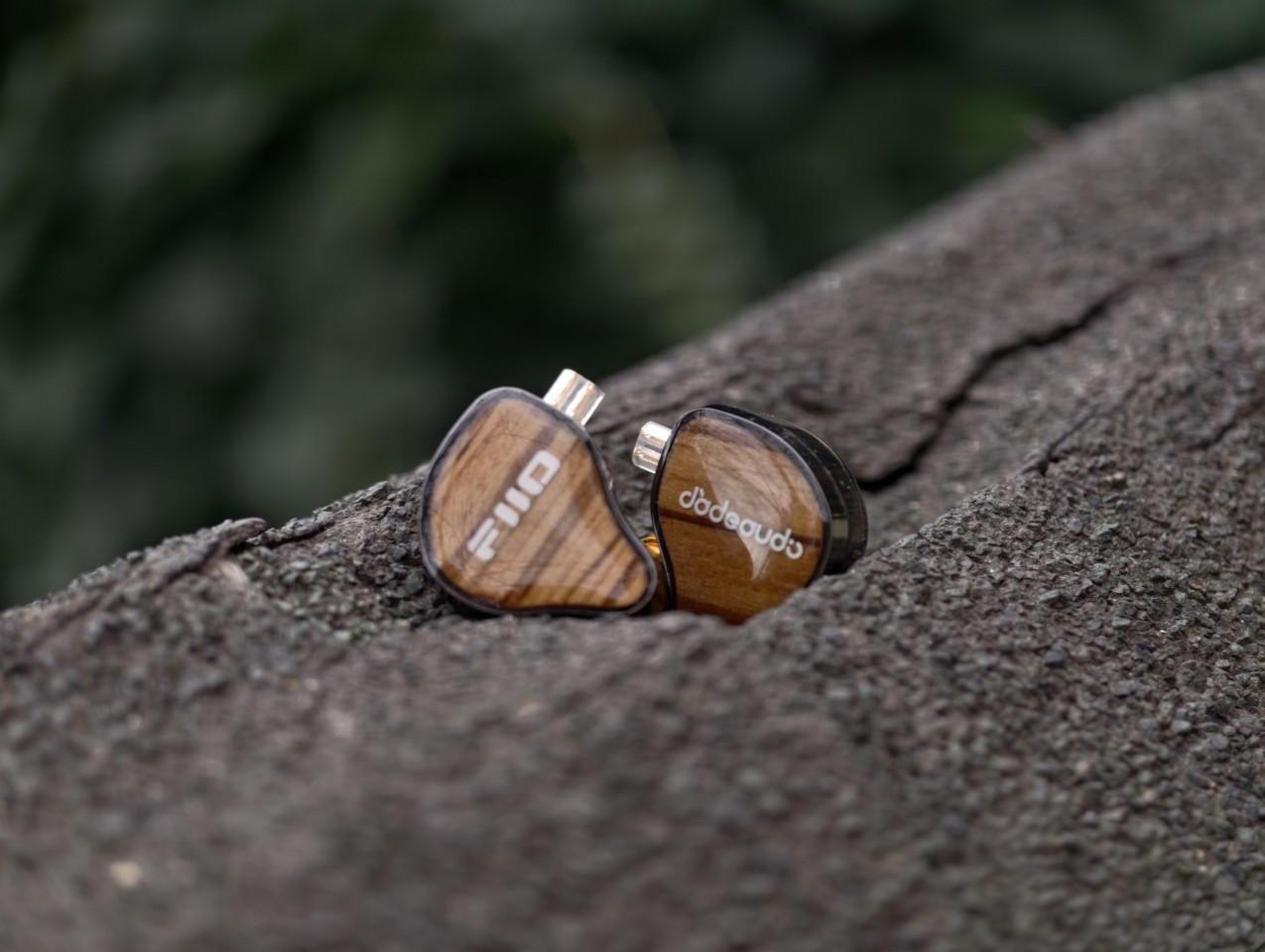
Real Zebrawood faceplates give the JH13 a distinctive natural aesthetic. Beyond the striking grain pattern, the material provides rigidity and stability, fitting seamlessly into the overall hybrid design philosophy. Each pair exhibits subtle variations typical of natural wood, giving the IEMs a unique visual signature that stands out in the entry-level category.
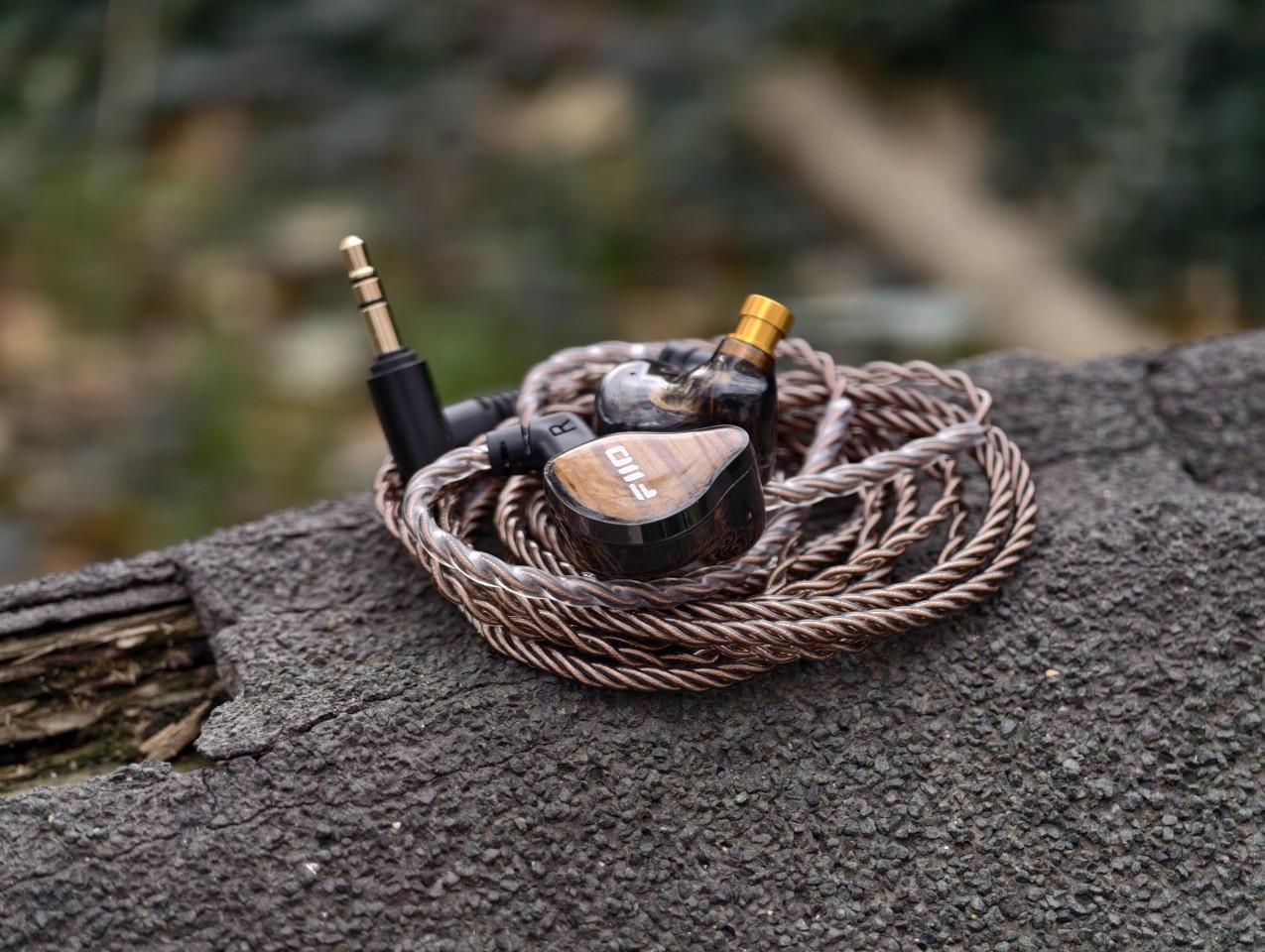
The included OFC cable measures approximately 1,2 m and features a 3,5 mm connector paired with 0,78 mm 2-pin plugs. Its over-ear routing reduces microphonic noise and enhances long-term comfort. At just 6,6 g per earpiece, the JH13 remains unobtrusive during extended listening sessions, making it ideal for everyday mobile use, commuting, or relaxed home listening.
Features
- Hybrid configuration featuring one dynamic driver and two balanced armature units
- 10 mm dynamic driver for extended bass response
- Dual BA system supporting clarity and high-frequency detail
- Frequency response rated from 10 Hz to 40 kHz
- Impedance of 24 Ω at 1 kHz and sensitivity of 110 dB/mW
- Real Zebrawood faceplates for a distinctive design
- 1,2 m OFC cable with 3,5 mm plug and 0,78 mm 2-pin connectors
- Low weight of 6,6 g per side without cable
- Hi-Res Audio certified
Specs
| Design | Hybrid In-ear Monitors |
| Drivers | 1× dynamic (10 mm), 2× Balanced Armature |
| Frequency Response | 10 Hz – 40 kHz |
| Impedance | 24 Ω @ 1 kHz |
| Sensitivity | 110 dB/mW @ 1 kHz |
| Weight | 6,6 g per side without cable |
| Cable Material | High-purity OFC |
| Cable Length | approx. 1,2 m |
| Connector Type | 3,5 mm to 0,78 mm 2-Pin |
| Certification | Hi-Res Audio |
Sound
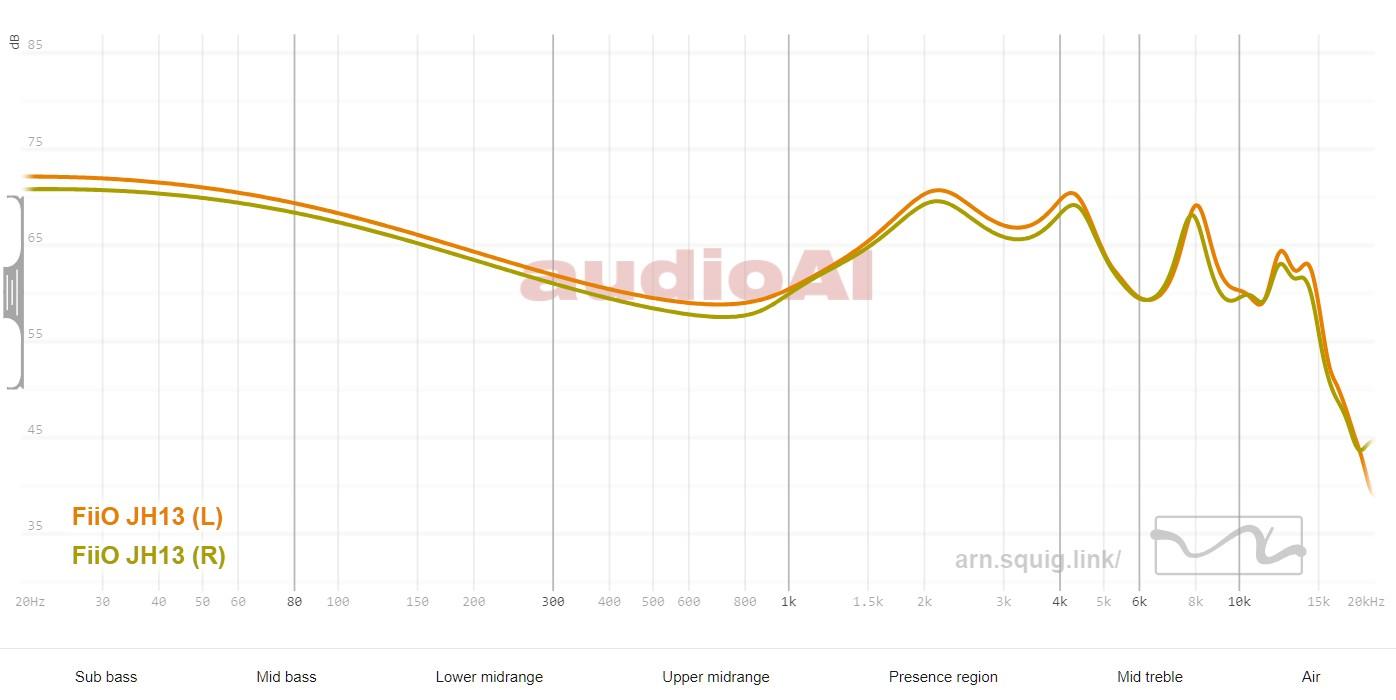
This frequency response graph for the FiiO JH13 reveals a tuning that prioritizes a “fun” and engaging sound signature over strict neutrality. With its hybrid configuration of a single dynamic driver and two balanced armatures, the tuning focuses on an impactful low-end and a vibrant upper-midrange presence.
Lows
The low end of the JH13 is characterized by a significant and broad emphasis that begins deep in the sub-bass and carries well into the mid-bass regions. Because a dedicated dynamic driver handles this, you can expect a physical sense of “slam” and air movement that balanced armatures often struggle to replicate. The curve shows a steady, warm slope that doesn’t just peak and drop; instead, it provides a thick, meaty foundation for the entire soundstage.

This tuning gives the kick drums a satisfying “thump,” and the bass guitars will feel authoritative. However, because the bass elevation continues quite far into the lower midrange, there is a noticeable “bass bleed.” This adds a sense of warmth and body to the sound, making it feel rich and “analog,” though it may sacrifice some surgical precision in favor of a lush, powerful atmosphere.
Mids
The midrange performance is a tale of two halves. The lower mids benefit from the residual warmth of the bass driver, giving male vocals and lower-register instruments a heavy, grounded feel. This prevents the IEM from sounding thin or clinical. As we move into the center of the midrange, there is a gentle recession—a classic “V-shaped” or “U-shaped” characteristic—which creates a sense of depth by pushing some instruments slightly back in the mix.
The upper midrange, however, sees an energetic rise. This peak is designed to bring vocals and the “snap” of snare drums forward, ensuring that, despite the heavy bass, the music doesn’t feel muffled. It provides the necessary clarity to keep the presentation engaging. The transition from the dynamic driver to the balanced armatures likely occurs around this region, aiming to balance the heavy low-end with articulate vocal delivery.
Treble
The treble response is handled by the balanced armature drivers, which are known for their speed and precision. The graph shows a series of peaks in the lower and mid-treble regions. These peaks are crucial for retrieving detail, such as the shimmer of cymbals or the breathiness of a vocal performance. It is a crisp tuning that aims to provide a sense of “clarity” to counteract the thick bass.

There is a noticeable dip following the initial treble peaks, which helps avoid excessive harshness or “sibilance”—that piercing sound on “s” and “t” consonants. However, the treble does maintain some energy into the higher frequencies before rolling off. This ensures that the JH13 doesn’t sound “dark,” providing enough air to keep the overall presentation from feeling closed-in.
Technicalities
Technically, the FiiO JH13 is built for musicality. The choice of a hybrid setup allows the IEM to multitask: the dynamic driver provides the visceral, “big” sound of the lows, while the dual balanced armatures focus on the intricacies of the highs. The channel matching between the left and right units appears exceptionally tight, which is a hallmark of good quality control and ensures a stable, centered phantom image.
The soundstage is likely perceived as wide but with a specific focus on “depth” due to the recessed center-mids and elevated bass. While it may not be the most “transparent” or “analytical” monitor for studio mixing, its technical strengths lie in its ability to deliver a high-energy, immersive listening experience that feels both powerful and detailed.
Sum-Up
With the JH13, FiiO delivers a hybrid in-ear monitor that blends modern driver technology, efficient magnet structures, and natural materials into a compact, budget-friendly package. Its combination of dynamic bass performance, detailed high-frequency response, and comfortable ergonomics makes it a compelling option for listeners seeking value without compromise. For mobile users and entry-level audiophiles, the JH13 stands out as a strong contender in its class.