

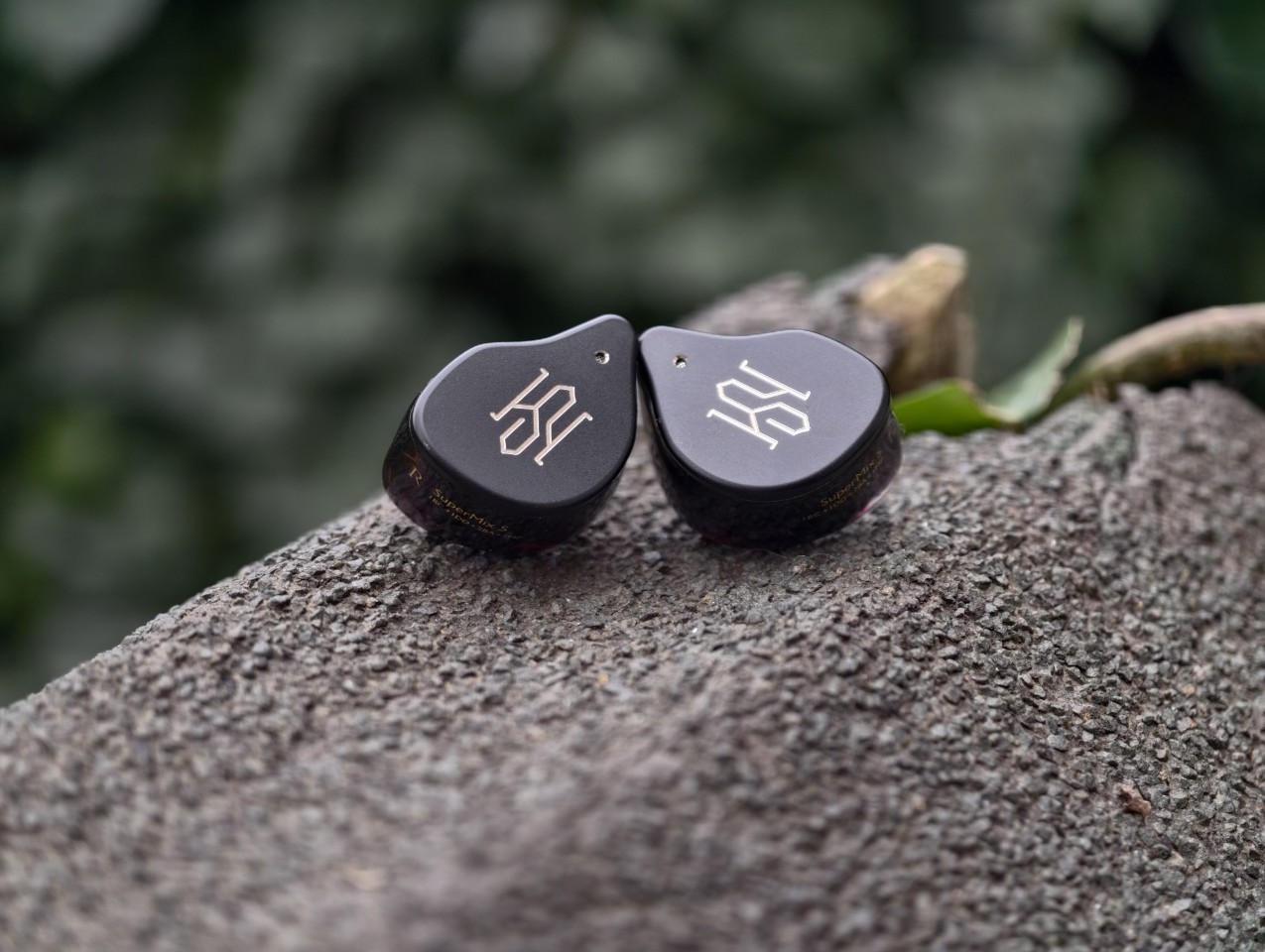
Kiwi Ears Astral Review – 1DD+6BA Monster Sound
The Kiwi Ears Astral is a professional-grade in-ear monitor (IEM) designed for music professionals and audiophiles, aiming for high resolution and tonal balance with its 1 dynamic driver and 6 balanced armature drivers.
Key Features
- Professional Design and Performance: The Kiwi Ears Astral is a high-end in-ear monitor developed for music professionals and astute audiophiles. It is engineered to deliver accurate audio resolution and a balanced tonal response. The design focuses on clarity and precision, ensuring that each component works together for faithful sound reproduction.

- Dynamic Driver Subwoofer: The Astral features a 10mm bioceramic diaphragm dynamic driver designed to reproduce low sub-bass frequencies. The driver produces a firm sub-bass thump that transitions smoothly into the bass range. The tuning of the bass includes a rolling cutoff at 300Hz to allow a natural flow into the midrange.
- Balanced Armature Driver System: The device incorporates six balanced armature drivers, arranged as two dual midrange drivers and a dual ultra-high frequency tweeter. The custom midrange drivers are designed to provide a neutral frequency response with a specific emphasis at 2.8kHz to match natural hearing. The tweeter has been modified to achieve a smoother ultra-frequency response that integrates seamlessly with the midrange.
- Tonal Signature and Tuning: The tonal profile of the Astral features a 9dB sub-bass shelf that transitions into the low-midrange with a cutoff at 300Hz. This design maintains a flat and neutral midrange, ensuring accurate sound reproduction. The treble is defined by a peak at 2.8kHz, which gradually rolls off up to 15kHz, extending the upper frequency range while avoiding harshness.

Inside the Box
- Kiwi Ears Astral x1
- Detachable Cable x1
- 3.5mm Plug x1
- 4.4mm Plug x1
- Ear Tips x3
- Headphone Case x1
- Warranty Card x1
The Kiwi Ears Astral arrives in a compact white box that, despite its simplicity, houses a thoughtful selection of accessories. Inside, users will find a zippered storage case, a modular cable, and a variety of ear tips.
The inclusion of two types of silicone ear tips and one set of foam tips is a welcome detail, providing options for different ear anatomies and sound preferences. This comprehensive accessory package ensures that users can achieve a comfortable fit and optimal sound isolation right out of the box.
Build & Design
The Astral IEMs boast a premium build, featuring 3D-printed resin shells that contribute to both durability and aesthetics. The opaque, glossy black finish, subtly infused with iridescent fragments, gives them a distinctive and appealing look. Users have the option to choose between blue and yellow accents, adding a touch of personalisation.

Two strategically placed vents are integrated into the design, essential for equalising air pressure and optimising resonance, which can impact sound quality and comfort. The IEMs are designed for universal wear, ensuring a snug and secure fit for most users. Their ergonomic shaping not only enhances comfort during extended listening sessions but also contributes to above-average passive noise isolation, making them suitable for noisy environments.

The stock cable is a highlight: a modular silver-plated copper design that allows for effortless switching between 3.5mm single-ended and 4.4mm balanced termination plugs. This versatility is a significant advantage, catering to various audio setups without the need for additional cables or adapters.
Specifications
- Sensitivity: 105dB (±1)
- Impedance: 23Ω (±1)
- THD (Total Harmonic Distortion): <1%
- Frequency Response: 10Hz – 22kHz
- Cable: Comes with a 1.2-meter detachable cable.
Pricing and Availability
- Price: $299.00
- Colours: Available in Blue and Yellow.
Disclaimer: The Kiwi Ears Astral was kindly provided by Kiwi Ears for review.
Sound
The Astral is marketed as a reference-grade, accuracy-first IEM, but I don’t fully agree with that portrayal. To my ears, it’s more of a well-thought-out U-shaped tuning with a neutral-warm tilt, where both the bass and treble regions are purposefully elevated. Rather than aiming for studio-flat neutrality, the Astral delivers an engaging, lively presentation that feels tuned to please a wide range of listeners.
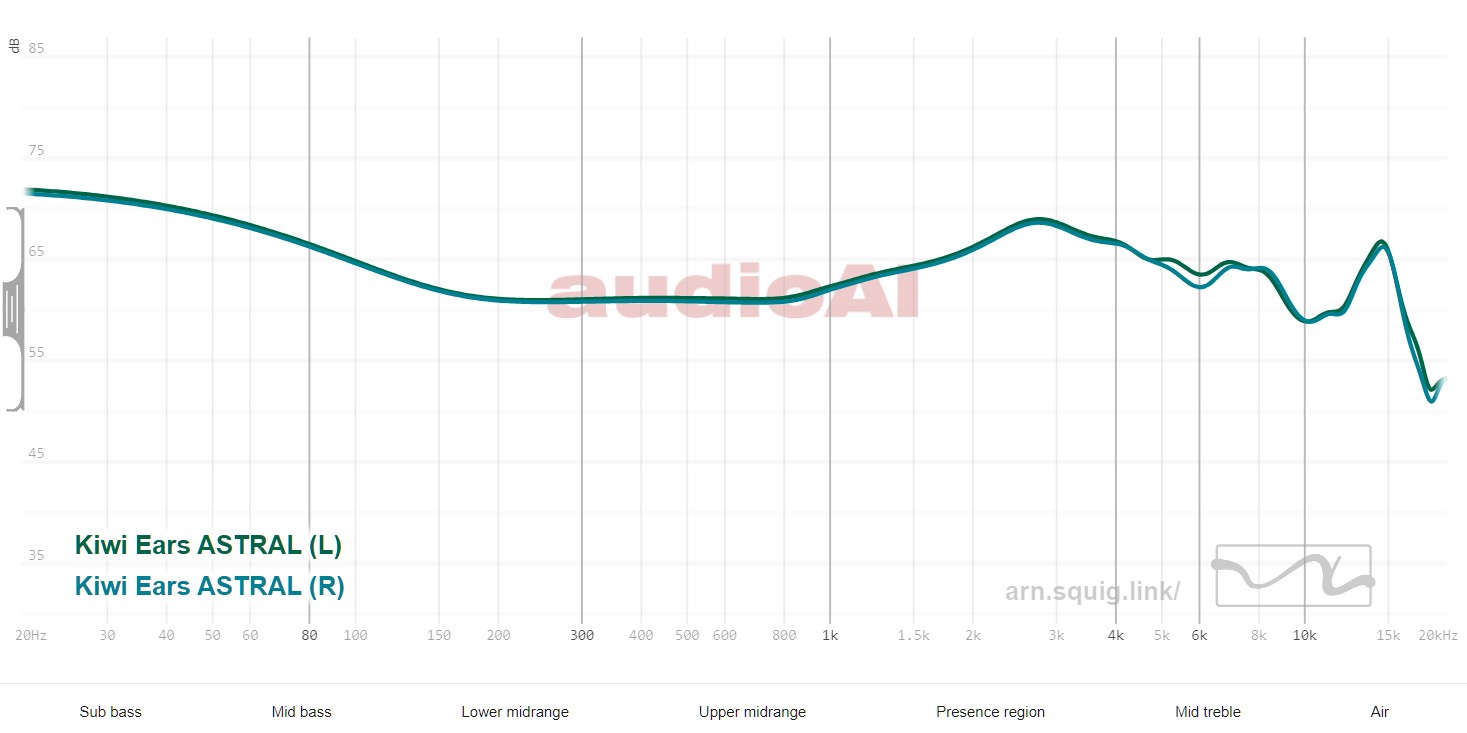
Both left and right channels track almost perfectly, which indicates strong quality control and a consistent sound between both ears. This helps with imaging accuracy and stereo balance.

Lows
The Astral has a solid, elevated bass presence. It looks like it provides a strong foundation and warmth without being overly boomy. This suggests it should feel impactful and satisfying for bass lines and drums, adding weight without overshadowing mids, providing a noticeable yet controlled rumble that extends deep into the lower registers.
The mid-bass, however, is subtly scooped out, resulting in a lean and agile bass response that avoids muddiness or excessive warmth.
While the bass provides a solid foundation, it maintains a lighter character, offering precise articulation without a heavy, visceral impact. This approach ensures that the bass remains impactful without overshadowing the rest of the frequency spectrum.

Mids
The midrange of the Astral is presented with an expansive and airy quality, creating a sense of openness and space. Vocals and instruments are brought forward in the mix, commanding attention with their clarity and presence.
The midrange gradually transitions from the bass, maintaining balance. It looks slightly recessed compared to the bass and upper mids, meaning vocals and instruments will sound clear but won’t jump too far forward. This tuning should deliver a smooth, non-fatiguing character, natural and relaxed, good for longer listening.
Despite their prominence, there’s a subtle dip in the lower mids that can impart a slightly lighter or more analytical tone to certain instruments and voices. This tuning choice contributes to the overall clarity and avoids any sense of congestion, allowing individual elements within complex mixes to be easily discerned.

Highs
The upper mids and lower treble are gently elevated, giving clarity and energy to vocals and high instruments. This helps maintain articulation and presence, making music feel lively without becoming harsh.
The treble performance of the Astral is a standout feature, characterised by its lightness and impressive extension. The high frequencies are rendered with excellent clarity and crispness, adding sparkle and detail to the sound without introducing harshness or sibilance.
The high treble remains extended and open, adding a sense of air and spaciousness. This contributes to a more open and less congested soundstage, helping fine details come through and avoiding a dull top end.

Technical Performance
Beyond its tonal balance, the Kiwi Ears Astral excels in its technical capabilities, which are particularly noteworthy given its competitive price point.
The soundstage presented by the Astral is remarkably spacious and well-defined, offering a broad and deep auditory canvas. This expansive stage allows for excellent instrument separation, where each element occupies its distinct position within the stereo image.

Imaging is precise and accurate, enabling listeners to pinpoint the exact location of instruments and vocals, creating a highly immersive and realistic sonic environment.
The Astral demonstrates impressive resolution and retrieval of fine details across the frequency spectrum. Subtle nuances in recordings, micro-textures of instruments, and the decay of notes are rendered with clarity, enhancing the listener’s appreciation of the music.
This high level of detail contributes to an engaging and insightful listening experience, revealing layers of information that might be missed on less capable IEMs.
Comparisons
vs Kiwi Ears Septet (1DD+4BA+1MPT+1PZT, $269)
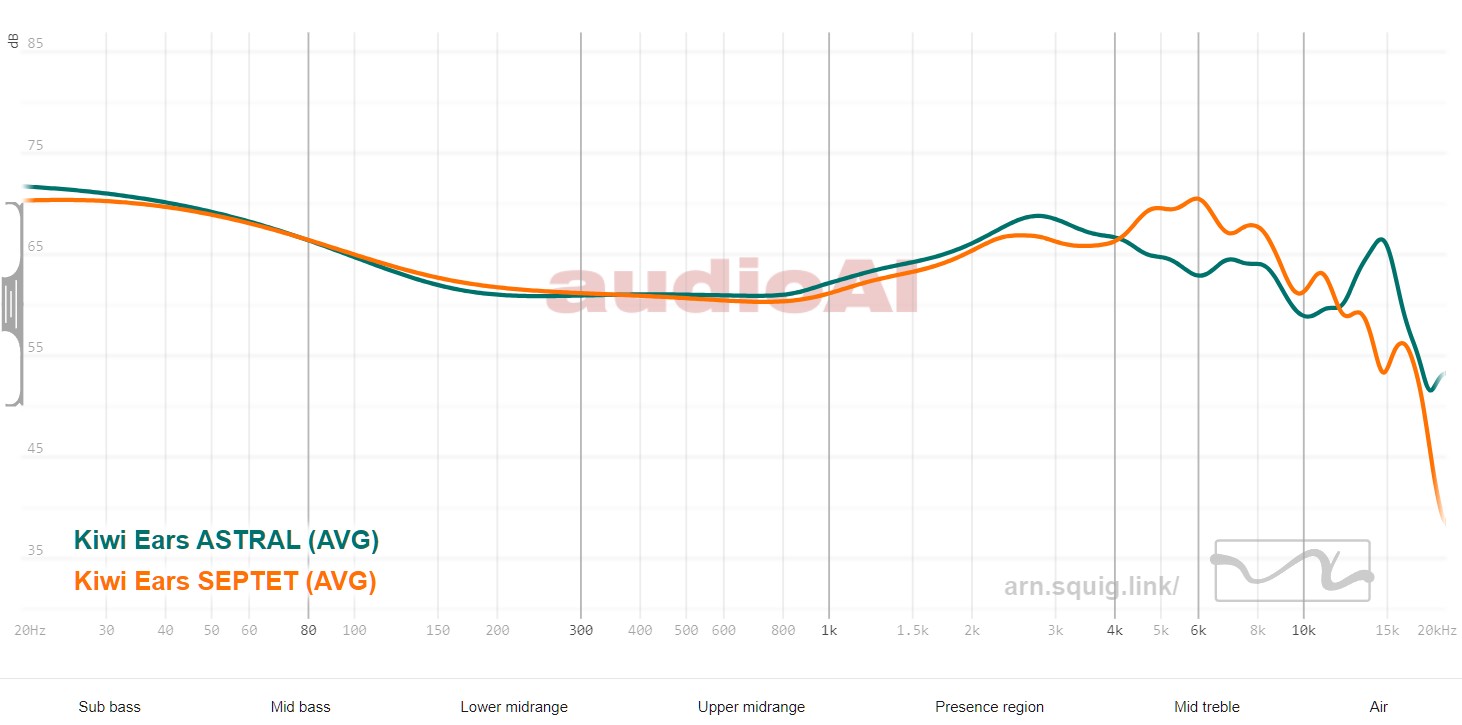
Bass (Sub-bass & Mid-bass)
Both IEMs have a similar bass region, but the Astral maintains slightly more presence and warmth (because of the treble tuning). This gives a fuller, rounder low-end character that might feel more supportive and weighted, while the Septet feels a bit leaner and cleaner here.
Midrange
In the lower and upper midrange, both sets have a smooth and fairly even approach, which keeps vocals and instruments natural. The Septet dips a little more, giving it a slightly more laid-back and spacious midrange, creating a “stage” effect where vocals are not as forward. Astral keeps them a touch closer and fuller.

Presence & Treble
This is where the differences become more obvious. The Septet shows a more energetic and lively treble region with extra peaks. This translates to a brighter, more airy, and detail-focused sound, but might also risk sounding sharper or more fatiguing to some listeners. The Astral is smoother and more controlled in this region, sounds more forgiving and easier on the ears over long listening sessions.
Air (Upper Treble)
Astral keeps slightly more extension at the very top, which can add a sense of openness and “air” without adding sharpness. The Septet rolls off more quickly, so it might feel a bit less spacious in the extreme highs despite the more aggressive mid-treble energy.
Overall impression
Astral: Balanced, slightly warmer, more forgiving. Better for those who want a smooth and natural listen with good bass support and a gentle treble.
Septet: Brighter, more energetic, more detail-forward. Suitable for listeners who want extra sparkle and excitement, but it might be more fatiguing for some.
vs IO Audio SOGNO (2DD+6BA, $399)
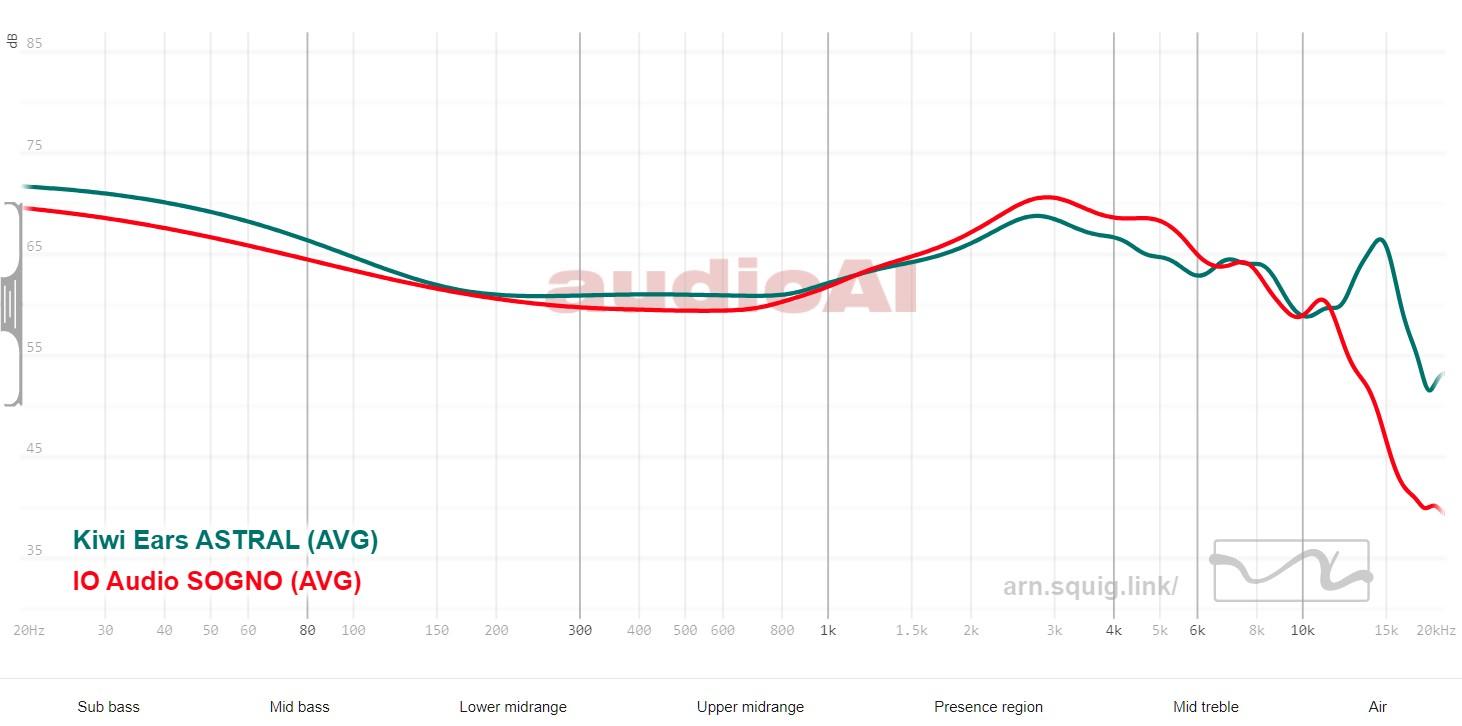
Bass (Sub-bass & Mid-bass)
The Astral holds a stronger bass presence overall, giving it a more powerful and weighty foundation. The Sogno’s bass is more restrained, which suggests a lighter, tighter, and more neutral low end that won’t dominate the mix.
Midrange
In the lower and upper midrange, the Sogno dips a bit more than the Astral. This usually makes vocals and instruments sit further back, creating a sense of space and separation, but possibly sounding thinner or less intimate. The Astral feels fuller and more forward here, which can make vocals sound more engaging and warmer.
Presence & Treble
The Sogno has a more prominent boost in the presence and mid-treble region. This can add extra brightness, detail, and energy, giving it a crisper and more analytical character. In contrast, the Astral is smoother and less aggressive in this area, which can make it easier on the ears and better for long listening.

Air (Upper Treble)
The Astral extends more in the very high treble (air region), suggesting a more open and spacious feeling at the top end. The Sogno drops off more quickly, which may sound a bit less airy but also avoids harshness.
Overall impression
Astral: More bassy, fuller, warmer, and smoother. Good for those who want a fun, rich, and safe listen without too much treble sharpness.
Sogno: Leaner, brighter, more revealing, and spacious. Ideal for those who like clarity, detail, and a lighter bass presentation.

Sum-Up
The Kiwi Ears Astral stands out as a competent and commendable in-ear monitor in its segment. Its strengths lie in its exceptional clarity, impressive resolution, and a balanced, articulate sound signature. The Astral appears to offer a warm, full-bodied bass, balanced mids, and a gently energetic but smooth treble. The result should be a versatile, easy-to-enjoy sound signature
Astrals’ robust technical performance in soundstage, imaging, and detail retrieval positions it as a strong recommendation for audiophiles and music enthusiasts seeking a high-performance IEM at a competitive price point.